Custonomy VS Treasure Data
Custonomy is an AI-Native Customer Data Platform (CDP) built for real-time personalization and predictive insights. Treasure Data, on the other hand, represents a traditional enterprise CDP model.

V/S

How Custonomy and Treasure Data Differ
Brands are redefining how they connect with every individual, not just by storing data, but by understanding and anticipating intent.
That is where Custonomy and Treasure Data take different paths.
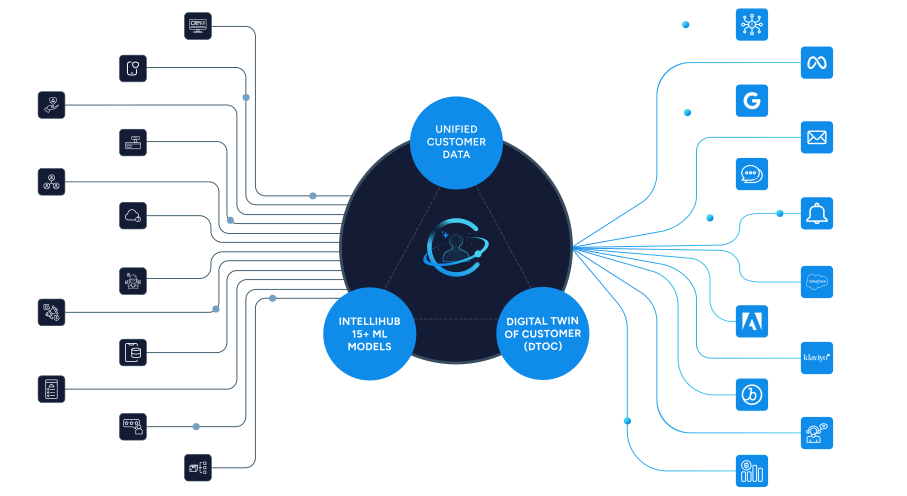
Custonomy is an AI-Native Customer Data Platform (CDP) built for real-time personalization and predictive insights. It empowers enterprises to create a Digital Twin of every customer, enabling continuous learning, contextual engagement, and AI-driven decision-making, all while keeping data within your secure cloud environment.
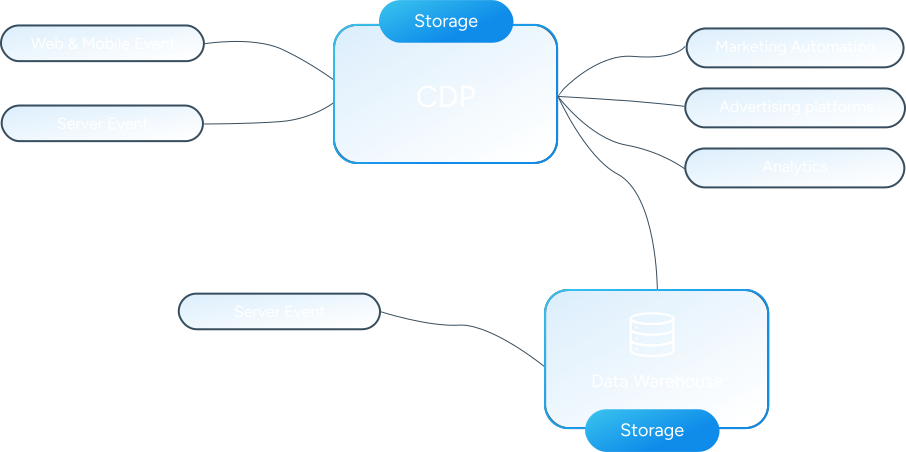
Treasure Data, in contrast, represents a traditional enterprise CDP model. It centralizes customer data across touchpoints and provides unified profiles for downstream activation. While robust in scale and integrations, its architecture depends heavily on proprietary data storage and longer implementation cycles.
This comparison helps you understand how Custonomy’s AI-native approach differs from Treasure Data’s traditional architecture, across dimensions such as scalability, data ownership, real-time decisioning, implementation speed, and business impact.
Custonomy vs Treasure Data: Feature-by-Feature Comparison
Both Custonomy and Treasure Data enable enterprises to unify and activate customer data, but they differ significantly in how they collect, process, and act on that data.
The table below highlights how both platforms compare across key dimensions that matter most to data-driven organizations.
| Feature | Treasure Data | Custonomy |
|---|---|---|
| Data Integration | Supports many connectors but relies on batch pipelines | Unified real-time ingestion from cloud, marketing, and offline systems |
| Identity Resolution | Deterministic stitching with limited customization | AI-powered deduplication, householding, and golden record creation in your cloud |
| Customer 360 | Centralized profiles updated in batch cycles | Real-time profiles combining demographic, behavioral, and transactional data |
| Predictive Intelligence | Offers AI tools but needs data science setup | Built-in ML for LTV, churn, and journey forecasting |
| Segmentation | Rule-based segmentation with limited automation | No-code segmentation with RFM, behavior, and affinity scoring |
| Personalization | Rule-based personalization, no native NBA | AI-driven recommendations and automated Next Best Actions |
| AI Insights & Agents | AI dashboards only, no autonomous agents | Integrated AI agents for insights and campaign optimization |
| Campaign Orchestration | Strong orchestration but needs external tools for execution | Create and run omnichannel campaigns directly from CDP |
| Real-Time Activation | Mostly batch-based activation with limited real-time | Instant audience activation via APIs and omnichannel sync |
| Scalability & Compliance | Enterprise-grade, compliance managed in TD ecosystem | Cloud-native, highly scalable, GDPR/CCPA compliant |
Pros and Cons of Each Platform
Custonomy: AI-Native Agility for the Modern Enterprise
Pros
- AI-Native Architecture: Designed around intelligent Digital Twins, enabling continuous learning and predictive engagement in real time.
- Secure: Works within your existing cloud infrastructure (AWS, Azure, or GCP), ensuring complete data ownership and governance.
- Real-Time Activation: Engage customers instantly with event-based triggers and omnichannel synchronization.
- Predictive Intelligence Built-In: Pre-trained AI models for churn, LTV, and next best action eliminate the need for complex data science setups.
- AI Agents for Insights: Autonomous marketing agents suggest campaigns, audiences, and personalization strategies based on live data.
- Faster Time-to-Value: Get live in weeks, not months, with minimal engineering dependency.
- Flexible Pricing: Transparent, usage-based pricing with no MTU dependency.
Cons
- Requires structured, accessible data within your cloud environment to unlock full AI potential.
May offer more configurability than some teams need if they are seeking a fully managed, out-of-the-box CDP.
Treasure Data: Traditional Power with Enterprise Depth
Pros
- Proven Enterprise Scalability: Trusted by global brands with complex data infrastructures.
- Unified Data Hub: Combines data from multiple channels into a central repository for activation and analytics.
- Strong Governance: Built-in compliance, data security, and privacy management capabilities.
- Advanced AI & ML Tools: Provides data science flexibility for enterprises with dedicated technical teams.
- Mature Ecosystem: Broad network of integrations with marketing and analytics platforms.
Cons
- Longer Implementation Cycle: Typically takes several months to deploy and customize.
- Limited Real-Time Capabilities: Relies heavily on batch processing for identity and activation workflows.
- Data Stored Externally: Customer data resides in Treasure Data’s managed environment, reducing direct control.
- Complex Maintenance: Requires ongoing engineering resources for data modeling, pipeline management, and orchestration.
- Rigid Pricing Model: MTU-based pricing can become costly as data volume or customer base grows.
Check Latest Case Study

How a CPG Giant Achieved 2X Click-Through Rate with Custonomy

Boosting ROI Through Predictive Promotions US-based Leading Retailer
Book a Demo
Which CDP Should You Choose?
Choosing the Right Customer Data Platform for Your Business
Both Custonomy and Treasure Data enable enterprises to unify, analyze, and activate customer data across channels.
The difference lies in how they approach the challenge.
Treasure Data offers a proven, centralized CDP that has powered enterprise-scale data operations for years. It’s well-suited for organizations seeking a fully managed environment, with structured processes and mature data governance.
Custonomy, however, reimagines the CDP for the age of AI and real-time intelligence. Its AI-native architecture empowers modern enterprises to not only unify customer data but to predict, personalize, and act instantly—all within their own cloud infrastructure.

The Verdict
If your business is ready to move beyond static customer profiles and traditional segmentation, Custonomy offers a smarter path forward.
By combining AI-powered customer intelligence, real-time activation, and composable flexibility, Custonomy transforms your CDP from a data warehouse into a living intelligence engine that drives every customer interaction.
In a landscape where speed, personalization, and adaptability define success, Custonomy isn’t just a CDP—it’s your enterprise growth engine.